
 TÜRKÇE
FAQ
Since solar energy is the system with the lowest price/cost, it is one of the most preferred renewable energy sources today. In addition, solar energy systems are unlimited, clean, easy to store. It is possible to see the SPP system from many areas, from traffic lights to factory roofs.
-
Do solar panels work in winter?

-
Last winter, there was much less snow than we are used to. We did not even feel the winter cold much. Sunny days were in the majority. In our country, we live the four seasons with all their beauties. Well, do solar panels work in winter? When the winter season comes, this question naturally appears in our minds.
A common misconception is that solar panels need heat to work. There is a perception that in warmer regions, more electricity can be produced from solar energy.
Solar panels harvest the energy in the sun. But they convert solar radiation into electricity, not the sun's heat. Contrary to popular opinion, higher temperature is not better. They work better when the weather is cold.
-
-
Do solar panels generate more electricity in cold weather?
-
In the winter, on a sunny day, your solar panel produces more electrical energy than it does in the summer. The reason why solar systems produce little electricity in total in winter is not the temperature, but the short days.
The most efficient solar power plants in our country are not in Adana, Mersin, and Antalya, but in our provinces in the inner regions. Despite being further north, the power plants operate more efficiently within the borders of Karaman province. The reason for this is that the air temperatures are also lower in the summer.
Whatever your solar energy system is, it will continue to produce electricity in winter. In cloudy weather, electricity generation will continue. The higher the cloud density, the less electricity produced. But whenever the weather is bright, there is more or less electricity production.
-
-
How advantageous is it to generate electricity from the sun?
-
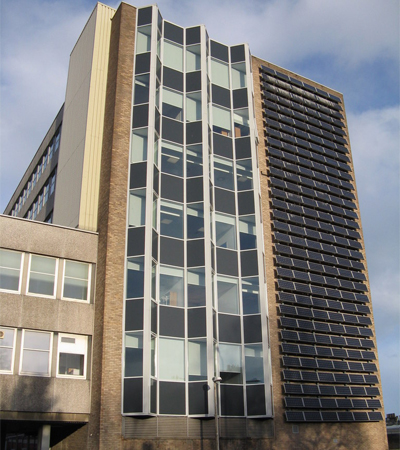 We see the building of the Jack Kilby computer center of Napier University in England. A photo taken at sunset. End of a beautiful sunny day for Scotland...
The building was built in the 1960s. As a computer center, it serves university students 24 hours a day, 7 days a week.
In 2005, the engineering faculty of the university and the "Energy Saving Trust" acted together to install 192 solar panels on the wall of the building. They set out with the aim of generating the energy of 80 computers from these panels. The system has an installed power of less than 10 kW.
At the same time, they are running a social project. You can watch how much electricity the panels produce from a screen at the entrance of the building. Thanks to the system, the reduced carbon emissions can also be viewed on the screen.
As we can see in the picture, it is not a very elaborate design. There are panels with shadows on them. Staff at the school have never seen the panels cleaned. Completely left to itself.
It is certain that it is working with less capacity than its installed power since it has not been cleaned. The system produced 35,000 kWh of electricity until 2009. In 2011, its production was 47,000 kWh and in 2016 it was 67,000 kWh.
More than 80 MWh of electricity produced.
It is known that as of 2018, its total production has exceeded 80,000 kWh. Its annual average is 5700 kWh/year.
The numbers may seem small. Because of the use of old technology panels, yields are low and you can imagine how little sun the north of England sees.
A good example showing how advantageous solar energy systems are… Probably, the system will continue to generate electricity without any maintenance until the end of the 2030s.
-

 Girne Mah. Girne Cd. No:117-121 K:5 Ofis:17 Omega Deniz Plaza, Maltepe-İstanbul


Luna Enerji 2021 © All rights reserved.